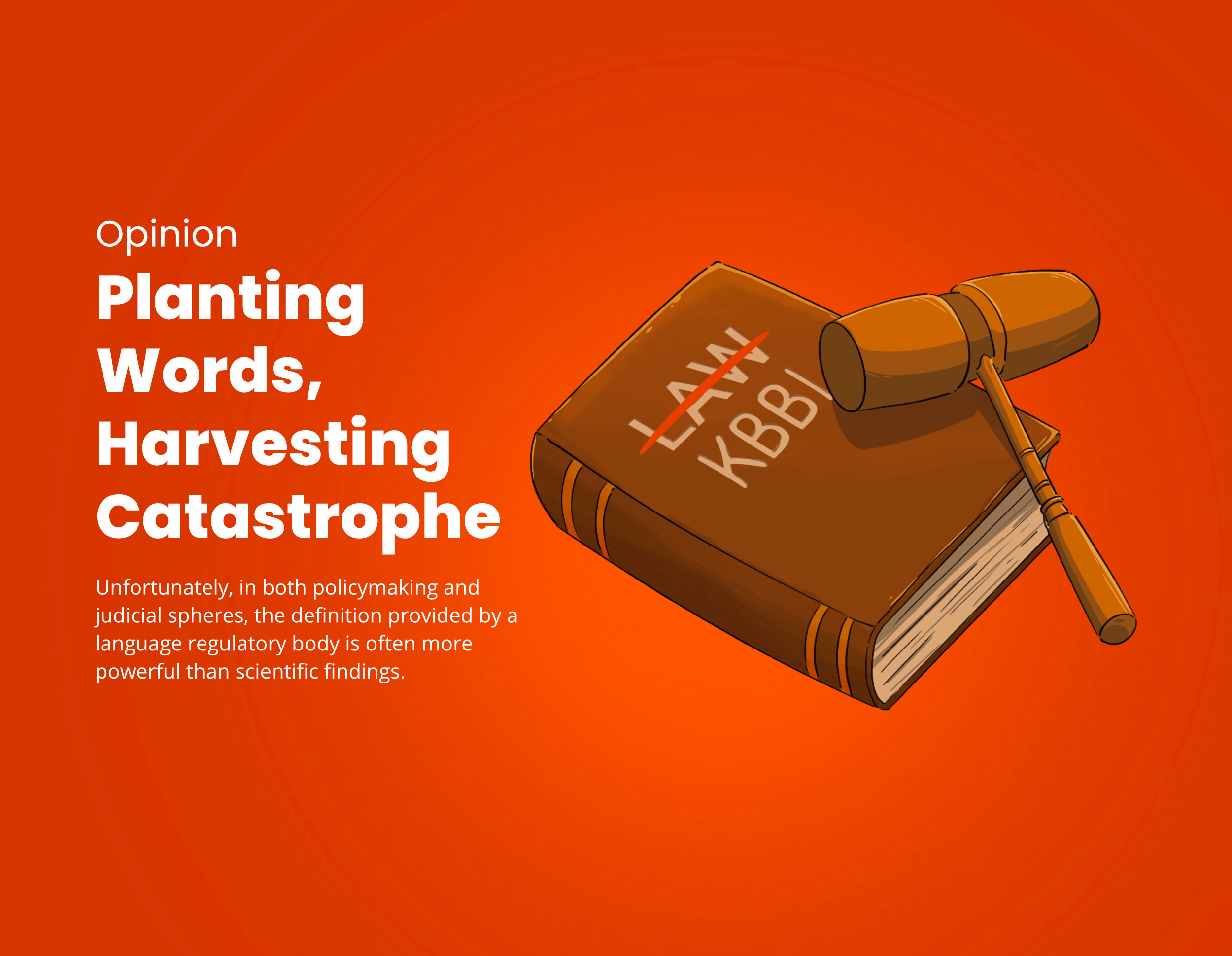
Without requiring millions of years of evolution, the Language Development and Fostering Agency has recently "elevated the caste" of palm oil (Elaeis guineensis) semantically within the Great Dictionary of the Indonesian Language (Kamus Besar Bahasa Indonesia/KBBI). From a mere plant, palm oil has been redefined as a tree. This may seem trivial, however, within policy-making circles and courtrooms, scientific definitions are often less powerful than those found in a dictionary.
This change is not merely about adding a term, but about how we frame the past, interpret the present, and view the future. Classifying palm oil as a tree allows for a reframing of history where it no longer records deforestation or the destruction of ecosystems, but rather the "replacement" of vegetation.
Furthermore, palm oil aligns with the government narrative that labels it a "miracle crop" for energy self-sufficiency while providing oxygen, rather than just a commodity. It will now carry a heavier ecological weight compared to other plantation commodities.
In the future, government claims regarding achievements like carbon neutrality or reforestation will no longer face obstacles. This is because palm oil will be classified and integrated into spatial planning maps as "Industrial Forest Plantations." This represents a clever "legal smuggling" accompanied by a betrayal of science for short-term economic interests, all without technically violating forestry laws.
In reality, botanically speaking, palm oil is a monocot. It is more closely related to grass or bamboo than to a teak tree. They share fibrous roots, lack true wood, and do not undergo secondary growth. Neither provides ecosystem services for peatland hydrology.
Based on data analysis from Pantau Gambut, there are currently at least 4.4 million hectares of palm oil cultivation rights (Hak Guna Usaha/HGU) concessions encroaching on peat ecosystems across Indonesia. Within these areas, approximately 263,356 forest and land fire hotspots have been recorded over the past decade.
These figures serve as evidence that the "tree," according to the Language Development and Fostering Agency, is the primary engine for draining peatlands through its lethal canals. Labeling palm oil a tree will not automatically stop it from depleting groundwater or releasing carbon emissions when its land is burned.
We must ask: since when does a language agency hold higher authority than botanists in determining species classification? Is this designation of "tree" status merely an attempt to legitimize a controversial academic opinion that has been publicly contested since 2018? Perhaps next, we will define smoke from forest fires as "morning mist" so that we no longer need to worry about air pollution indices.
A dictionary should be a mirror of reality, not a tool for whitewashing or facilitating ecological sins. If language continues to be manipulated to justify environmental destruction, then we are facing more than just an environmental crisis; we are experiencing a bankruptcy of reason. Disrupting a narrative will not rewet dried peatlands or cool the planet.
A forest is a complex ecosystem, not merely rows of monocultures forced into a dictionary definition just to appear green on paper.