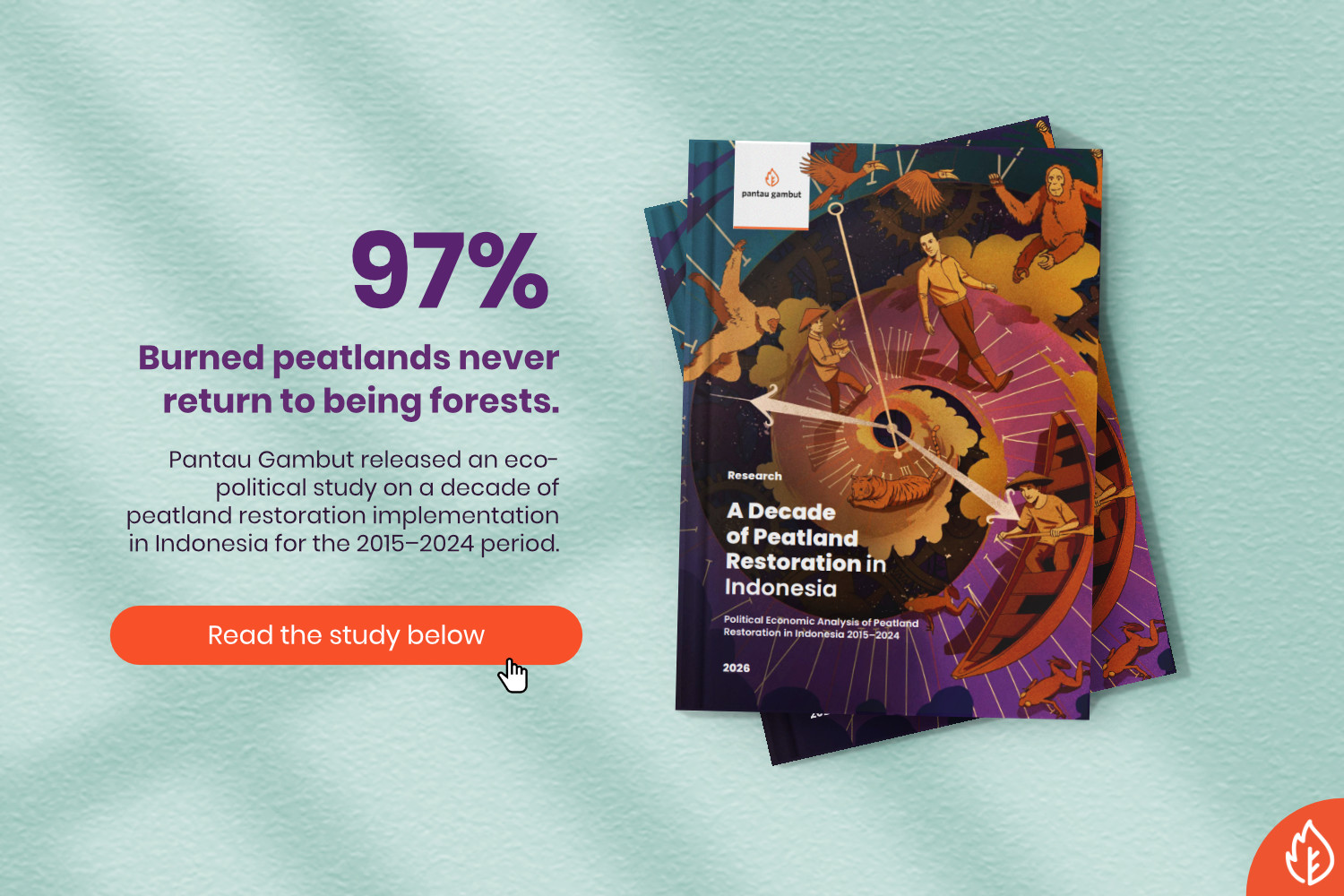
Launched in the aftermath of the massive forest and land fires in 2015 and President Joko Widodo's pledge at COP21 in Paris, the restoration program that implemented through the Peatland Restoration Agency (Badan Restorasi Gambut/BRG) and later the Peatland and Mangrove Restoration Agency (Badan Restorasi Gambut dan Mangrove/BRGM), has operated under intense international scrutiny and received billions of dollars in climate finance. Yet, following the end of BRGM's mandate in December 2024, Pantau Gambut has released findings that challenge these claims of success into question.
Pantau Gambut's monitoring reveals a number of findings that contradict the government's official narrative:
- The restoration target was reduced from 2.6 million hectares to 1.2 million hectares, yet it still remained unmet by the end of BRGM's mandate.
- 70% unit of the canal blocks observed were found to be damaged, with most constructed from wood and bamboo that deteriorate rapidly without regular maintenance.
- 52% intervention sites still recorded a Groundwater Table below the safe threshold, indicating that peatlands remained dry and highly susceptible to fire despite restoration efforts.
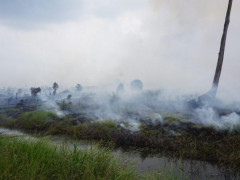
- Fires continue to recur in the same locations, including areas where peatland rewetting infrastructure has already been installed.
Among peatlands affected by fire between 2015 and 2019, only 3% have regenerated into forests. The remainder has become shrubland (41%) or been converted into monoculture plantations, primarily oil palm (54%). The same pattern was observed within concession areas. Pantau Gambut assesses these burned shrubland areas may have been intentionally prepared for future plantation expansion, a practice that explicitly violates existing regulations.
Using the environment-making state framework, this research argues that peatland restoration cannot be understood solely as an ecological conservation effort. Rather, it functions as a state instrument for restructuring peatland landscapes so it can remain compatible with capital accumulation, whether through monoculture plantations or carbon market mechanisms.
Unless restoration efforts move beyond administrative target compliance and confront the structural causes of degradation, namely the expansion of monoculture concessions, unequal agrarian access, and weak law enforcement within concession areas, peatland recovery will continue to stagnate.
Pantau Gambut calls for a fundamental transformation: from an area-based restoration approach to a governance model that is ecologically measurable, transparent, and responsive to the needs of local communities, which have long borne the greatest burden of Indonesia's peatland crisis.
The full research report on peatland governance and the politics of wetland space can be downloaded through the link below.