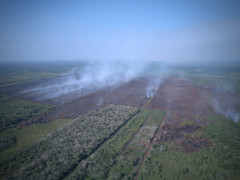
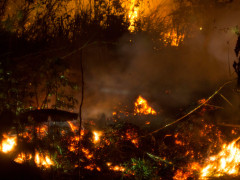
The Tripa Peat Swamp ecosystem is one of Aceh’s peatland ecosystems, covering an area of 61,803 hectares across Southwest Aceh Regency and Nagan Raya Regency. This ecosystem forms part of the Leuser Ecosystem Area (Kawasan Ekosistem Leuser/KEL), which has been designated as a National Strategic Area for environmental conservation. In accordance with Aceh Qanun No. 19 of 2013 on the Aceh Spatial and Regional Planning (Rencana Tata Ruang Wilayah/RTRW), peatland areas with a peat depth exceeding three meters in Nagan Raya Regency are classified as protected areas.
Unfortunately, the essential functions of the Tripa Peat Swamp are under serious threat due to land clearing and ecosystem degradation. Based on satellite imagery analysis, only approximately 15% of primary forest remains to perform critical functions such as carbon storage, freshwater cycle regulation, and serving as a natural buffer against disasters including forest and land fires, flooding, and tsunamis. The Director of Apel Green Aceh, Rahmad Syukur, stated that “between 10 and 15 hectares of forest in the Tripa Peat Swamp are lost each day as a result of land clearing and ecosystem destruction.”
Throughout 2025, analysis conducted by Apel Green Aceh recorded the loss of nearly half of the total forest cover in the Tripa Peat Swamp. Apel Green identified the loss of 2,393 hectares of forest cover, leaving only 4,172 hectares remaining. When compared to forest cover conditions in the Tripa Peat Swamp since the 1990s, approximately 93.25% has been lost, primarily due to land-use conversion activities and logging associated with the former concession area (ex-HGU) of PT Kalista Alam. This outcome is reflected in the Decision of the Suka Makmue District Court No. 747/PKN.W1-U22/HK2.4/V1/2025, which states that PT Kalista Alam voluntarily complied with the court ruling in the case filed by the Ministry of Environment and Forestry.
Based on observations conducted by the Apel Green Aceh team throughout 2025 and into early 2026, no restoration activities were identified as having been carried out by either PT Kalista Alam or the government. This situation indicates a lack of commitment on the part of the authorities to implement the court’s ruling, particularly with regard to restoring the Tripa Peat Swamp ecosystem.
Wahyu Perdana, Advocacy, Campaign, and Communications Manager at Pantau Gambut, stated that “the fragility of Indonesia’s ecology, particularly in Aceh, is not merely the result of extreme weather, but rather stems from the government’s perspective, which oversimplifies peatland ecosystems as issues of boundary delineation, production, and licensing alone.” He further emphasized that when forest cover above peatland ecosystems is lost, the likelihood of forest and land fires as well as flooding increases significantly.
A study conducted by Pantau Gambut found that at least 281,253 kilometers of canals, most of which are located within concession areas, have cut through peatland ecosystems across Sumatra, Kalimantan, and Papua. This length is equivalent to traveling the Trans-Java Toll Road back and forth 120 times. The canal network spans plantation concessions (Hak Guna Usaha/HGU) covering 3,993,626 hectares and industrial timber plantation (Hutan Tanaman Industri/HTI) permits totaling 2,547,356 hectares. These findings demonstrate a strong correlation between extractive activities and the increasing incidence of disasters resulting from peatland degradation.
Executive Director of Forest Watch Indonesia (FWI), Mufti Barri, added that “the ratification of the revised Forestry Law (Law No. 41 of 1999) has become an urgent matter, as the existing law is no longer fully relevant to current forest governance dynamics.” At present, the revision of the Forestry Law is being intensively discussed by Commission IV of the Indonesian House of Representatives (DPR RI), as it is closely linked to issues of climate change, tenure conflicts, and the role of Indigenous peoples in safeguarding forest ecosystems.
On the other hand, there is pressure from various stakeholders for the revision of this law to tighten standards for natural forest protection and to ensure accountability in permitting as well as the credibility of monitoring mechanisms. The Forestry Law revision should also strengthen prevention and restoration functions, so that forestry policy becomes an ecosystem-based disaster risk reduction tool, rather than merely an administrative instrument for land management.
Given these circumstances, we emphasize that the revision of the Forestry Law should be directed toward strengthening three key pillars.
- Prioritizing the protection of hydrological functions and disaster prevention in high-value and vulnerable ecosystems such as peatlands.
- Designing law enforcement mechanisms that ensure the restoration of degraded land as a primary obligation, which cannot be postponed through administrative negotiation, and which is tied to measurable indicators and independent audits.
- Promoting transparency and accountability in governance, creating space for public monitoring, and strengthening measures to prevent conflicts and environmental damage at the field level.