COP 30 in Brazil, serving as a diplomatic forum for countries on environmental issues, positions the management of forests, oceans, and biodiversity as one of the key strategic pillars for discussion. The meeting will also reaffirm global climate action from each participating country. Unfortunately, Indonesia’s implementation of its promise to achieve net-zero carbon emissions from the forestry sector (FOLU Net Sink) still seems far from realization. The sector that was expected to absorb greater amounts of carbon emissions has instead become a net source of emissions.
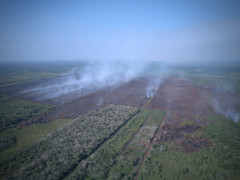
Comparative analysis of annual data on the number and distribution of forest and land fires shows a relatively consistent pattern. Madani Berkelanjutan and Pantau Gambut have identified several regions that continue to serve as fire epicenters with high incident rates. Out of a total of 308,000 hectares of Indicative Burned Area (Area Indikatif Terbakar/AIT), West Kalimantan has been identified as the province with the largest AIT between January and September 2025, covering 123,076 hectares. Alarmingly, 78,267 hectares of this area fall within the operational plan of the subnational FOLU Net Sink program.
Peatland ecosystems are not exempt from the same challenges. Pantau Gambut recorded a total burned area on peatlands of 26,761 hectares during July and August, with Riau and West Kalimantan emerging as the provinces with the largest affected peat ecosystems. Alarmingly, 56% of forest and land fires during the same period occurred within areas licensed for oil palm Right to Cultivate (Hak Guna Usaha/HGU) and Forest Utilization Business License or Forest Utilization Business Permit (Perizinan Berusaha Pemanfaatan Hutan/PBPH operations).
Putra Saptian, Campaigner at Pantau Gambut, noted that “institutional fragmentation remains a persistent source of problems. In reality, an ecosystem such as peatlands functions as an integrated whole that cannot be divided administratively or sectorally.” The separation of the Ministry of Environment and the Ministry of Forestry has further increased the complexity of coordination, bureaucracy, and governance.
Furthermore, the non-renewal of the Peatland and Mangrove Restoration Agency (Badan Restorasi Gambut dan Mangrove/BRGM) has further weakened peatland restoration efforts. Madani Berkelanjutan noted that following Presidential Regulation No. 120 of 2020, BRGM lost the authority to monitor and supervise concession areas and regions that are at particularly high risk of fire. Without this authority, BRGM is unable to ensure effective maintenance of restoration infrastructure within concession zones.
Deputy Director of Madani Berkelanjutan, Giorgio Budi Indrarto, explained that “the dissolution of BRGM reinforces a recurring pattern in Indonesia’s environmental governance: agencies are established during crises and subsequently dismantled once pressure subsides. This pattern reflects an ad-hoc approach that relies on emergency logic rather than long-term institutional design. In this context, BRGM was not only never fully institutionalized, but from the outset, it was not designed to endure.”
“To achieve climate targets, particularly in the FOLU sector, government efforts cannot be sectoral. All agencies must work in synergy toward a shared vision, reducing deforestation and forest and land degradation, especially in peatlands. If large-scale land clearing continues and forest and land fire management remains suboptimal, Indonesia’s efforts to meet the unconditional 31.89% and conditional 43.20% carbon emission reduction targets will become increasingly difficult. COP 30 in Brazil risks becoming little more than an empty show,” concluded Sadam Afian Richwanudin, researcher at MADANI Berkelanjutan.