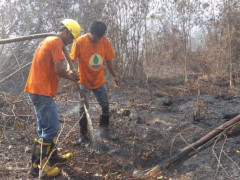
Far from the bustle of urban life, the sounds of nature and the rhythms of Indigenous life that have endured for centuries in South Papua are now increasingly drowned out by the roar of machinery. In the name of "development" to achieve national food and energy security, an entire way of life is preparing to confront mass displacement.
The Indonesian government appears to have learned little from the humanitarian crisis brought about by extreme industrialization in Northern England, which culminated in the Great Depression of the 1930s. These conditions were documented by George Orwell in “The Road to Wigan Pier”. It’s demonstrate how environmental destruction contributed directly to the devastation of landscapes, the alienation of communities, and the widening of social segregations.
The Mystification of Meaning
The government frames ambiguous notions such as "prosperity" and "progress" as objectives that can only be achieved through investment, land conversion, and increased production. More troublingly, this narrative ambiguity and double standard do not remain confined to public discourse, but are translated directly into formal legal instruments.
From a regulatory perspective, these policies have been institutionalized as instruments for accelerating the development of National Strategic Projects (NSPs). Forests and peatlands that have long served as a freely accessible "supermarket" for meeting the daily needs of local communities are formally claimed by the state. On paper, the government legitimizes the appropriation of these living spaces through a series of rapidly enacted regulations. The mystification of meaning is embedded within bureaucratic documents, where the loss of Indigenous forests is reframed as the "fulfilment of the public interest."
The Orchestration of Four State Institutions
To advance President Prabowo Subianto's ambition, four state institutions have assumed strategic roles in the implementation of the project:
- Ministry of Forestry: Releasing Forest Areas
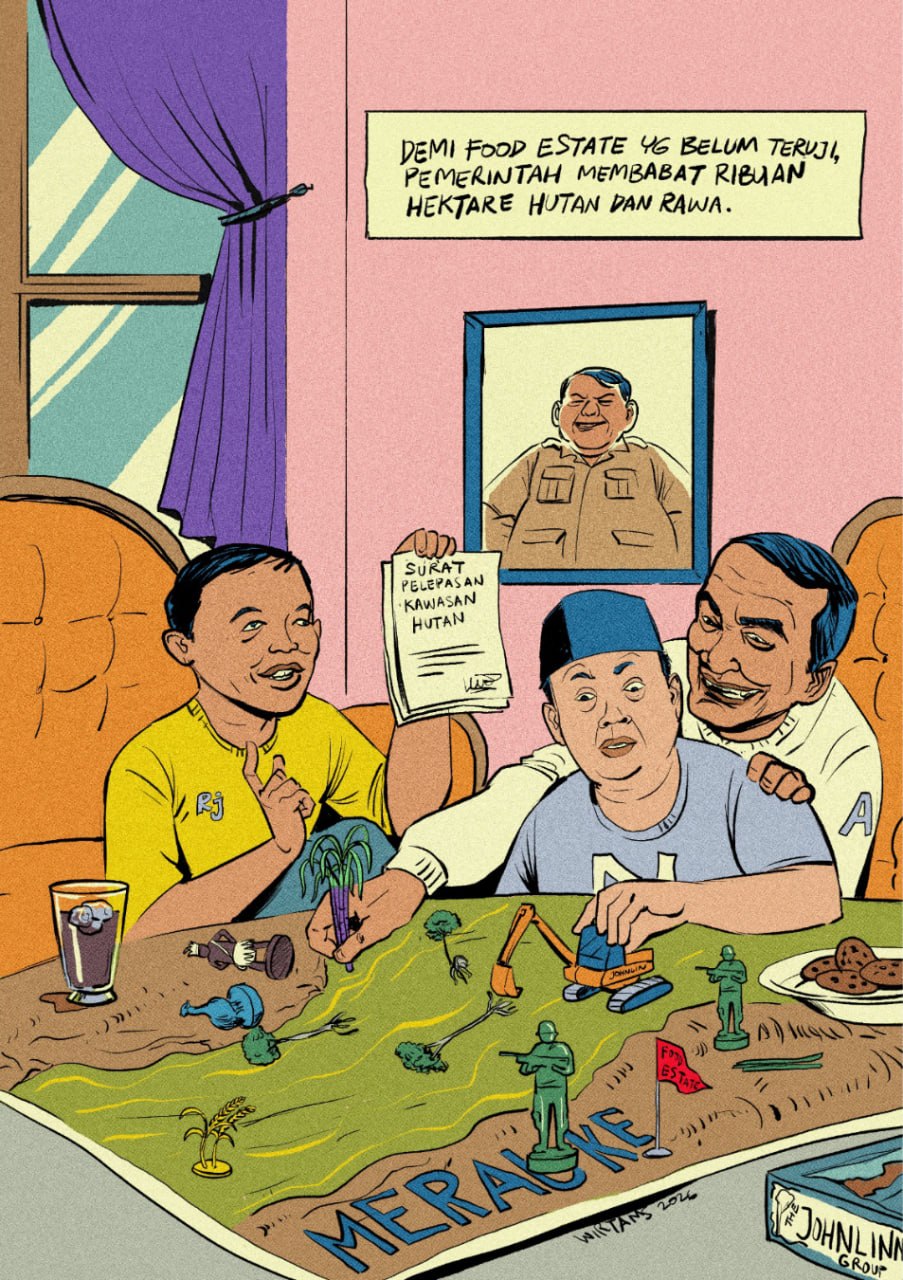
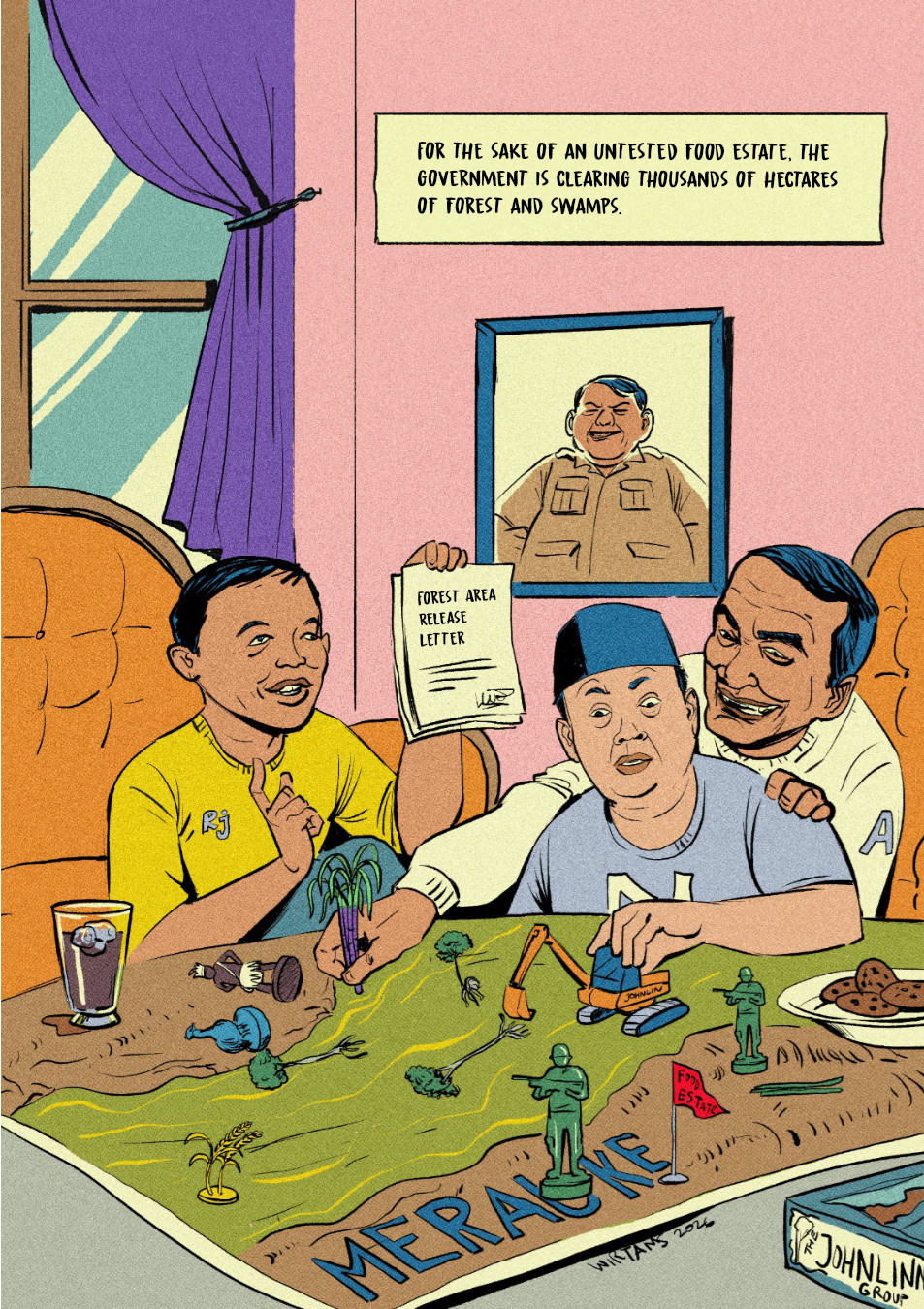
Through Ministerial Decree No. 591 of 2025, issued by Minister Raja Juli Antoni, the government redesignated 486,939 hectares of forest areas in Merauke, Boven Digoel, and Mappi as Other Land Use Areas (Areal Penggunaan Lain/APL) to support the National Strategic Project (NSP).
- Ministry of Agrarian Affairs and Spatial Planning/National Land Agency (ATR/BPN): Legalizing Land through Spatial Planning (RTRW)
Once forest areas have been released, Minister Nusron Wahid takes the lead in removing legal obstacles related to land status and overlapping Indigenous land claims in order to accelerate land provision for the project.
- Ministry of Agriculture: Providing the Infrastructure for Food Estate Implementation
Under the leadership of Amran Sulaiman, this technical ministry is responsible for achieving national production targets through the implementation of the National Strategic Project for national food, energy, and water production areas.
- The Indonesian National Armed Forces (Tentara Nasional Indonesia/TNI): Field Executor
Once the necessary conditions have been established, the TNI take part as the role of field executor responsible for large-scale implementation. Yet, under Indonesian law, the military has no authority to determine land status, acquire land, issue land titles, redesignate forest areas, or resolve land disputes.
The issue becomes even more concerning when the government officials heroically claim to have transformed and "optimized" swamp landscapes for the National Strategic Project. In the context of South Papua, the disappearance of peatlands cannot be separated from the threat it poses to a civilization that existed long before the Indonesian state itself.
Socio-Ecological Characteristics and the Threat to Totemism
From the perspective of South Papua's socio-ecological characteristics, the large-scale loss of forests represents far more than a change in land use. The policy also threatens the relationships of Indigenous communities, which for centuries have been shaped through social, economic, cultural, and spiritual ties with forests, peatlands, rivers, and the wildlife that inhabit them.
In anthropological studies, animals, plants, peatlands, and forests often occupy a special place as symbols of Indigenous spiritual identity through a system known as totemism. Totems are not merely visual symbols, they represent the social relationships between humans, their ancestors, and the natural world. They also embody the relationships between particular animals, plants, or natural elements through the identity of clans and kinship groups.
When wildlife habitats or these landscapes are degraded through exploitation, what is lost is not only biodiversity but also the spaces through which the Indigenous Peoples of South Papua express and reproduce their cultures. Access to sovereign food sources (such as sago, swamp fish, wild boar, and other forest resources) for many communities will also be cut off. More critically, the destruction of these ecological spaces disrupts the intergenerational transmission of knowledge. Future generations risk losing the opportunity to know their customary territories, understand the histories of their clans, and inherit the values that have long governed the relationship between people and nature.
A Critique of the Development Orientations
This reality exposes the mystification of "well-being" in contemporary development practices. Well-being is presented as something that can be achieved through investment, land conversion, and increased production. Yet, at the very same time, the very foundations of Indigenous well-being are placed at risk of destruction.
Accordingly, this macroeconomically biased conception of "well-being" must be subjected to more comprehensive scrutiny. Rather than asking how much food the project is capable of producing, the more fundamental questions are: Who will benefited? Who bears the risks? And what do Indigenous communities stand to lose when forests and peat swamps are transformed into production landscapes despite repeated evidence of failure?
The degradation of South Papua's peat swamp ecosystems is likely to generate social and cultural costs that far exceed the short-term economic benefits being promised. Development must not be reduced to the expansion of economic output and commodity production alone. Otherwise, the rhetoric of well-being becomes little more than a justification for capital-driven exploitation whose consequences cannot be compensated for in monetary terms.