By Abil Salsabila
from Pantau Gambut
Regulations in Indonesia are much like a "regulatory jungle" that can lead anyone astray who ventures into them. This is especially true when examining the regulations governing the very forests themselves. A long colonial history has left behind a multitude of legal legacies whose underlying logic continues to shape governance today, including within Indonesia's peatland landscapes.
Menjelajahi Rimba Regulasi Gambut Indonesia

Until at least 1990, peatlands remained one of the few landscapes that had yet to be formally recognized within Indonesia's regulatory framework. As development accelerated and available land became increasingly scarce, President Soeharto issued Presidential Decree No. 32 of 1990 on the Management of Protected Areas (hereinafter Presidential Decree No. 32/1990). The decree was intended to serve as a guideline for both legal entities and individuals in planning and implementing development programs in a prudent and sustainable manner.

Article 3 of Presidential Decree No. 32/1990 stipulates that Indonesia's Protected Areas comprise four categories, namely Areas Providing Protection for Downstream Areas, Local Protection Areas, Nature Reserves and Cultural Heritage Areas, and Natural Disaster-Prone Areas. Among these categories, Article 4 of Presidential Decree No. 32/1990 classifies Peatland Areas as part of the Areas Providing Protection for Downstream Areas.

According to the decree, Peatland Areas are defined as areas whose soil consists predominantly of accumulated organic matter deposited over long periods, with a peat depth of three meters or more, located in the upstream reaches of rivers and swamps. Although peatlands were thus designated as a category of protected area, they were not governed by a dedicated law of their own. In fact, technical regulations specifically addressing peatland protection and management were only introduced in 2014 through Government Regulation No. 71 of 2014 on the Protection and Management of Peatland Ecosystems.

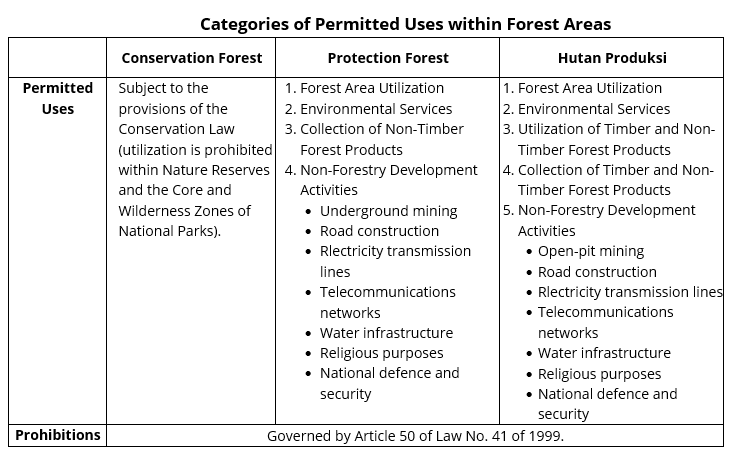
Nevertheless, peatland ecosystems remain subject to various laws governing environmental protection, forestry, and spatial planning. Following the enactment of Law No. 5 of 1967 on Basic Forestry Provisions, later superseded by Law No. 41 of 1999 on Forestry, Indonesia's landscapes were formally divided into Forest Areas and Non-Forest Areas (Article 1(3), Law No. 41/1999). Pursuant to Article 6 of Law No. 41/1999, the Government further classifies forests into three principal functions, such as conservation forests, protection forests, and production forests. Each forest function is governed by its own management regime, including specific activities that are either permitted or prohibited within its designated area. Consequently, peatland ecosystems located within Forest Areas are managed in accordance with the principal function of the forest area in which they are situated.

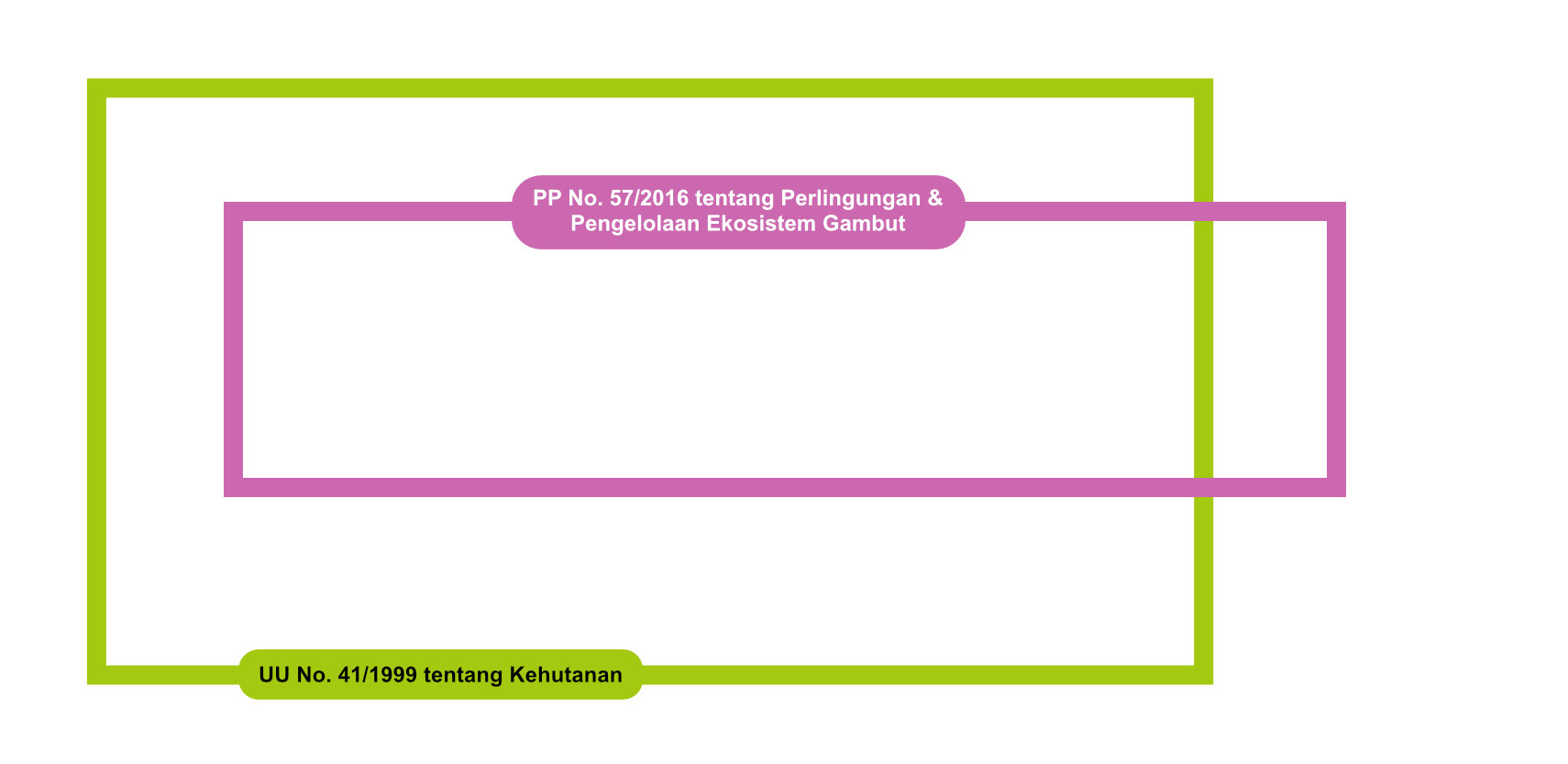
Although the table above indicates that extractive activities, such as mining and Industrial Plantation Forests (Hutan Tanaman Industri/HTI), are permitted within Protection Forests and Production Forests, such activities must be excluded where peatland ecosystems designated as Protection Functions under Government Regulation No. 71 of 2014, as amended by Government Regulation No. 57 of 2016, are present within these forest categories. This is because the legal principle of lex specialis derogat legi generali applies, whereby a more specific rule prevails over a more general one.

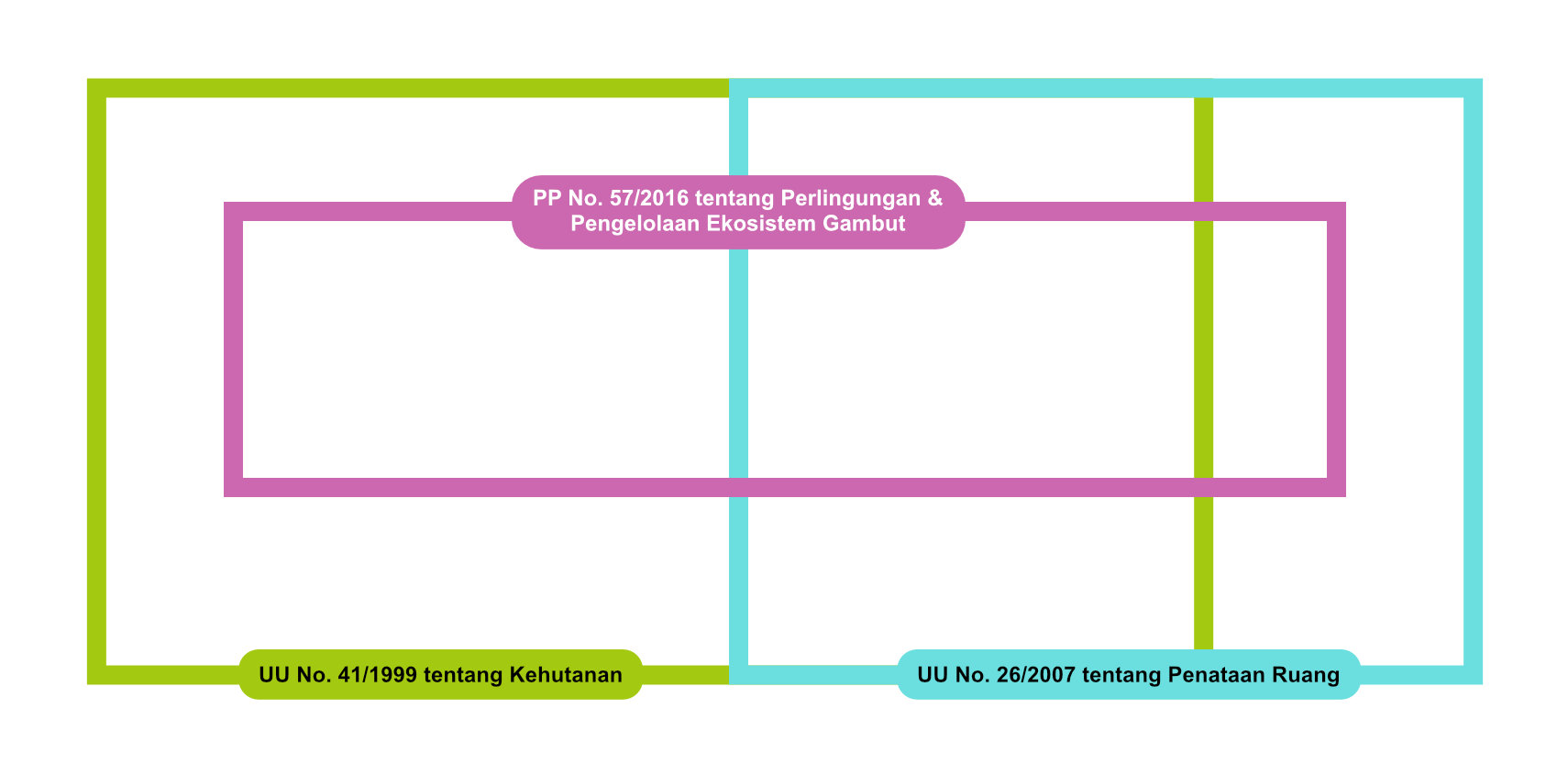
In addition to the Forestry Law, peatland governance also intersects with Law No. 26 of 2007 on Spatial Planning. This is because Article 5(2) of the Law stipulates that spatial planning based on the primary function of an area comprises two categories, which are protected areas and cultivation areas. Furthermore, Law No. 26 of 2007 emphasizes that all spatial planning, from the national to the village level, must adhere to this framework. Consistent with Presidential Decree No. 32 of 1990, the category of protected areas within the spatial planning regime also includes peatland areas (Elucidation of Article 5(2) of Law No. 26 of 2007). Accordingly, all forms of spatial planning should be guided by the distribution of peatland ecosystems, together with the functions and restrictions attached to them.

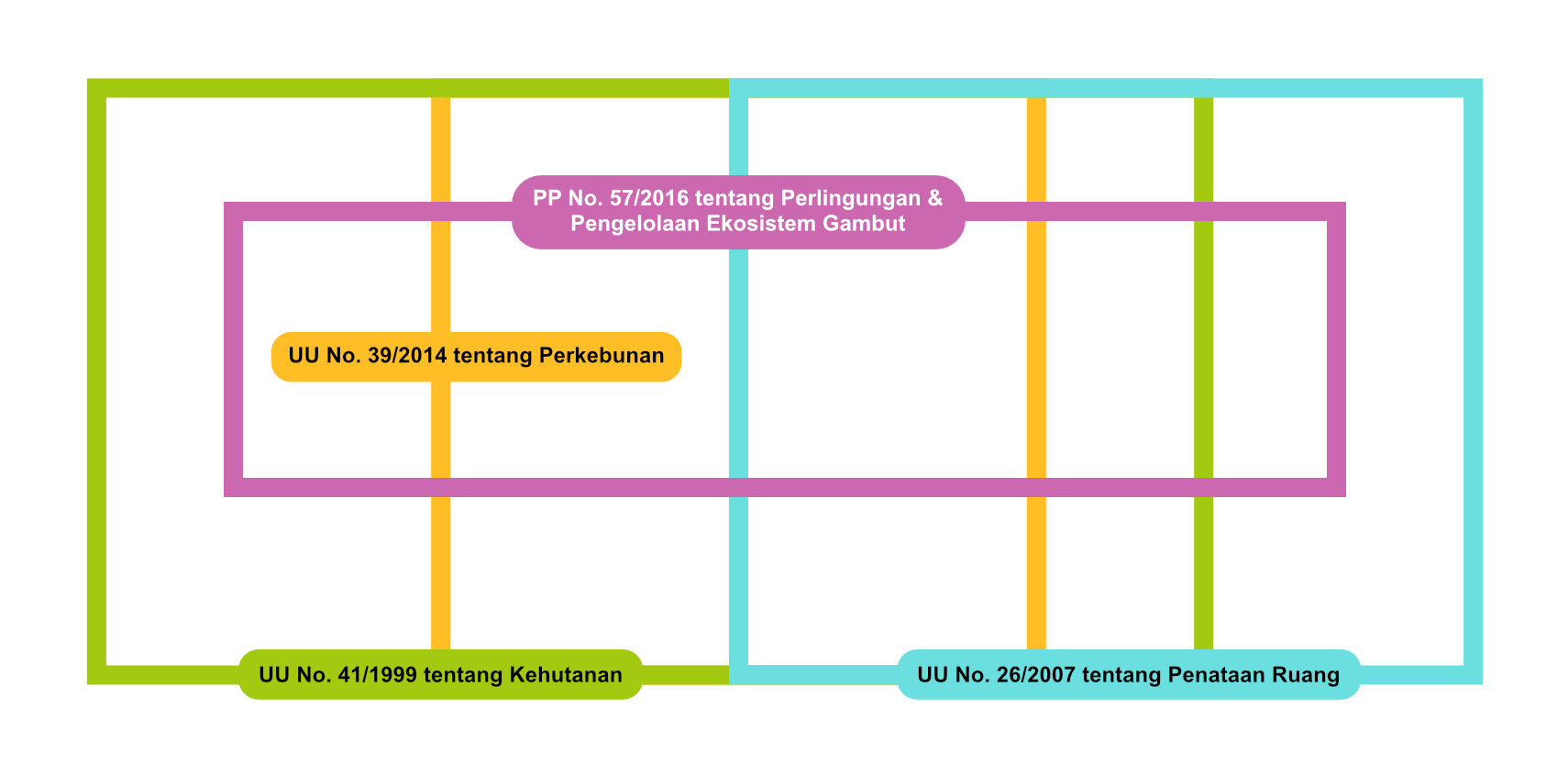
The presence of plantation activities on peatland ecosystems also brings peatland governance within the scope of Law No. 39 of 2014 on Plantations. Article 56(1) and (2) prohibit the clearing and/or cultivation of plantation land through burning and require all plantation business actors to establish systems, facilities, and infrastructure for the prevention and control of land and plantation fires. Likewise, Article 67 of the same Law obliges plantation operators to maintain environmental sustainability and comply with environmental requirements as a prerequisite for obtaining business permits.

From all the sectoral laws discussed above, Law No. 32 of 2009 on Environmental Protection and Management (EPM Law) serves as the primary legal umbrella governing peat ecosystem management and forms the legal basis for the issuance of Government Regulation No. 71 of 2014, as amended by Government Regulation No. 57 of 2016, as stated in the Preamble (Menimbang) section. Article 57 of Law No. 32/2009 stipulates environmental maintenance shall primarily be carried out through the conservation of natural resources.

The Elucidation of the article further explains that natural resource conservation encompasses the conservation of water resources, forest ecosystems, coastal and marine ecosystems, energy resources, peatland ecosystems, and karst ecosystems. Accordingly, the protection of peatland ecosystems constitutes an integral component of environmental protection and management. Therefore, any activities that pose a serious threat to and/or cause damage to peatland ecosystems are subject to the enforcement mechanisms provided under Law No. 32/2009.

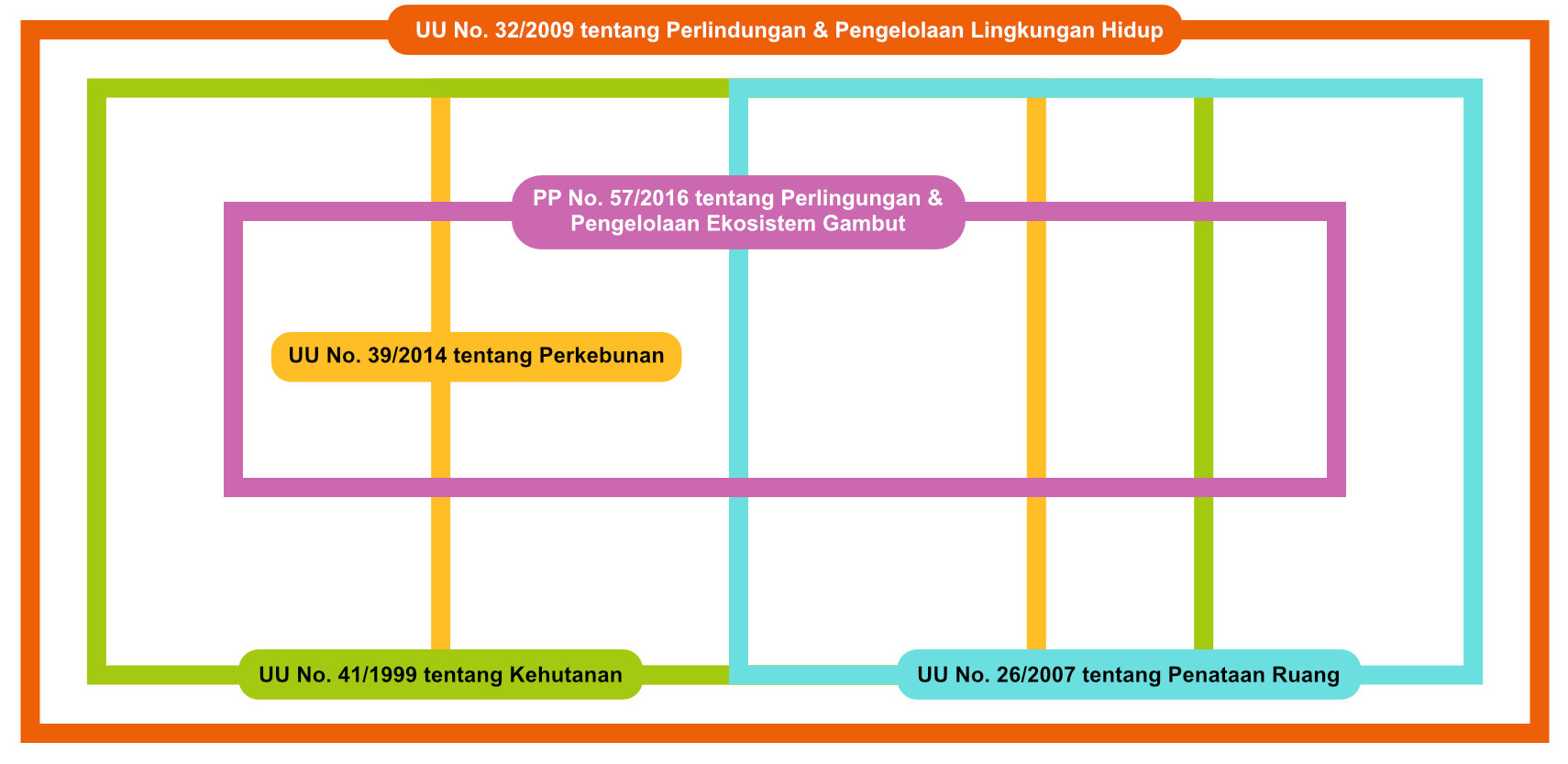
The regulatory framework anchored in different ministries and government agencies, such as Law No. 41/1999 (Ministry of Forestry), Law No. 32/2009 (Ministry of Environment), Law No. 39/2014 (Ministry of Agriculture), and Law No. 26/2007 (Ministry of Agrarian Affairs and Spatial Planning/National Land Agency), has given rise to normative conflicts. For instance, while Government Regulation No. 71/2014, as amended by Government Regulation No. 57/2016, prohibits cultivation activities within peat ecosystems designated as protection functions, the Forestry Law still permits their conversion into Industrial Plantation Forests (Hutan Tanaman Industri/HTI) when such protected peat ecosystems are located within Production Forest Areas.

In 2024, Pantau Gambut identified an HTI concession operated by PT. Bumi Mekar Hijau (BMH) within a protected peat function area of the Sugihan River-Lumpur River Peat Hydrological Unit (PHU) that recorded a Groundwater Table (GWT) depth of up to 140 cm below the ground surface. This numbers demonstrates that although the legal principle requires more specific technical regulations to prevail over more general ones, in practice the institutional interests of sectoral and territorial authorities (e.g., Forest Areas versus non-Forest Areas) have proven to be more dominant.

From the foregoing discussion, we can observe the true face of peat ecosystem governance in Indonesia: one marked by complexity, sectoral fragmentation, and overlapping authorities. While this article may not fully untangle the "regulatory jungle" surrounding peat ecosystem protection and management, it is intended, at the very least, to serve as an introductory map for navigating it.


Support Us

Share this information with your family and friends.